Chimney leak repair in Rockaway, NJ
Find where the water gets in, then fix that.
A chimney leak shows up in one place and starts in another. Most failed repairs are a correct fix applied to the wrong spot.
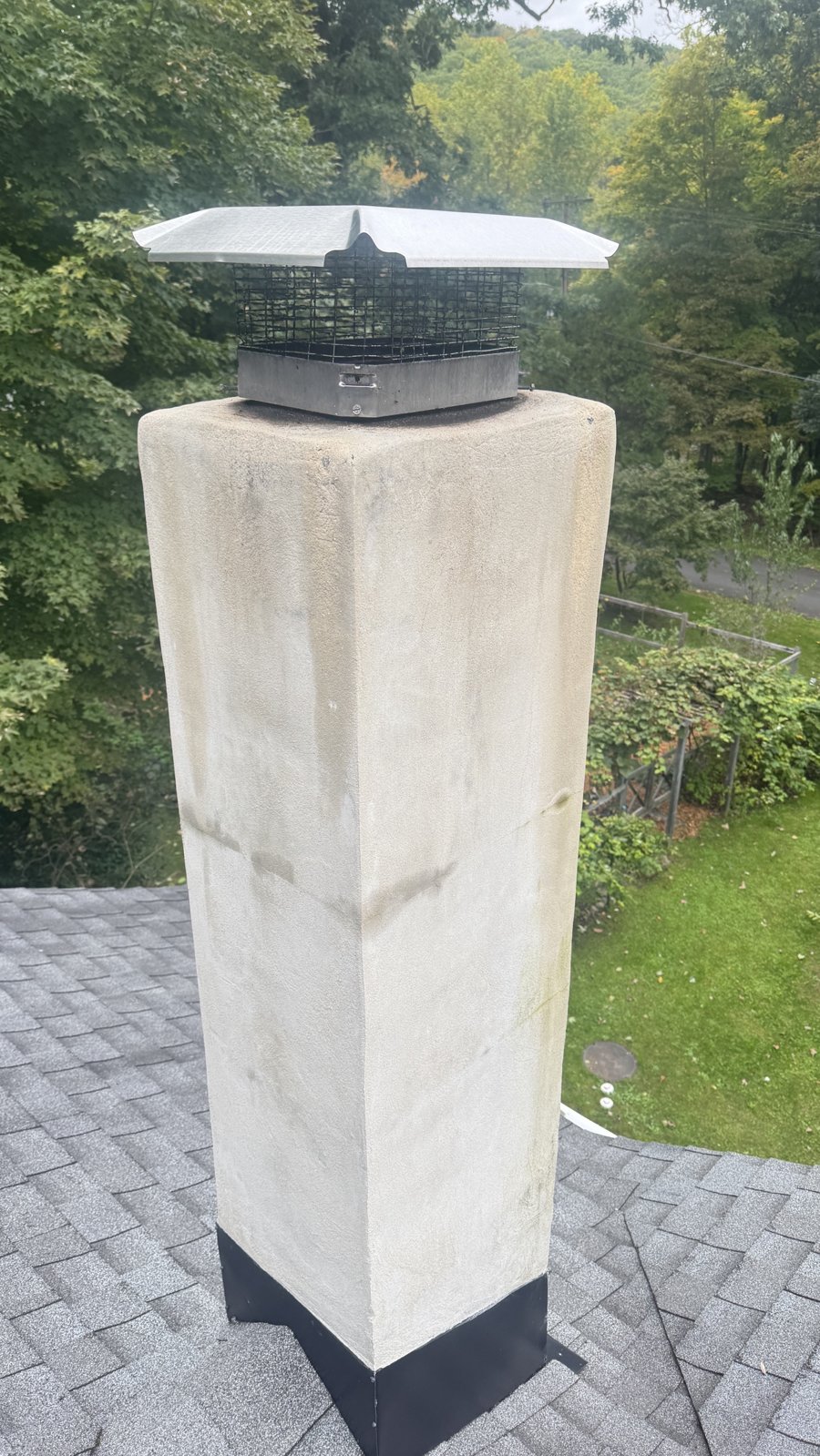
Rockaway Borough and Rockaway Township cover a lot of hilly, wooded ground, from the borough streets out past White Meadow Lake and Lake Telemark. Shade and tree cover keep chimneys damp long after a storm, which is why so many here carry the green and black streaking in the photo above. That streaking is not dirt. It is a map of where water has been running.
The chimney in that photo shows three separate ways water can get in, on one stack. That is typical. A chimney leak usually has more than one source, and fixing only the obvious one is why so many leaks come back.
Where chimney leaks actually start
The cap. A missing cap lets rain straight down the flue. A cheap painted or galvanized cap rusts, the screen opens up, and the lid stops covering the opening in a driving rain. Water down the flue rusts the damper and soaks the smoke chamber.
The top of the chimney. On a masonry chimney that is the crown, the concrete slab around the flue. On a framed chimney it is the chase cover. Either one needs to slope away and overhang the walls so water drops clear. When the top is flush with the walls, or stucco is simply rounded over the edge as in the photo, every drop that lands on top runs straight down the face of the chimney.
The walls. Brick and mortar absorb water. Stucco sheds it until it cracks, and then it lets water in behind the finish, where it cannot dry. A horizontal crack with staining below it, like the one wrapping this chimney, is a place water has been getting in and freezing.
The flashing. Where the chimney meets the roof, metal step flashing should be woven into the shingles and covered by counter flashing set into the chimney. When it has been replaced with a smear of roof cement, or the counter flashing is only caulked to the surface, it holds for a season or two and then opens up.
Inside the flue. Not every chimney leak is rain. Gas furnaces and water heaters put out a lot of water vapor, and in an oversized or cold flue it condenses and runs down the inside. That leak gets worse in cold, dry weather rather than in storms, and no amount of waterproofing fixes it. The fix is a liner sized to the appliance.
How to narrow it down yourself
When it leaks tells you a lot. A leak during any steady rain usually points to the top: the cap or crown. A leak only during wind-driven storms points to the walls or the flashing on the side facing the weather. A leak in cold weather with no rain, often with white or rust-colored staining near the appliance connection or the cleanout, points to condensation.
Where it shows up helps too. Water in the firebox or around the damper usually came down the flue. A stain on the ceiling or wall right beside the chimney usually came through the flashing or the chimney wall above the roof.
How we fix a chimney leak
First the inspection. We go up, photograph the cap, crown, walls and flashing, and look at the flue from the top. When condensation is a possibility, we look at what is venting into the chimney and how. You get the photos before we talk about scope.
Then we fix what is actually letting the water in, and only that. A stainless cap sized to the flue. A crown rebuilt with a real overhang and drip edge, or a sloped stainless chase cover on a framed chimney. Cracked stucco or failed mortar cut out and repaired to sound material. Step and counter flashing done properly instead of more roof cement. A correctly sized liner when the water is coming from inside.
When the walls themselves are absorbing water, the last step is a breathable masonry water repellent, the kind that lets the chimney dry out from the inside. Paint and general-purpose sealants trap water in and make things worse.
Common questions
Why is my chimney leaking?
Almost always one of five places: the cap (missing, rusted or the wrong size), the crown or chase top (cracked, or built with no overhang), the chimney walls (porous brick or cracked stucco soaking up rain), the flashing where the chimney meets the roof, or condensation forming inside the flue. They produce the same stain on the ceiling, which is why the fix has to start with finding which one it is.
Is a leaking chimney a roof problem or a chimney problem?
Usually a chimney problem that shows up as a roof problem. The flashing at the roofline is the shared border, and roofers often reseal it with more roof cement and leave. If the water is coming in higher up, through the cap, crown or the chimney walls, it runs down inside the chimney past the flashing and the leak continues no matter how much sealant goes on at the roof.
Why does my chimney only leak during heavy, windy storms?
Wind-driven rain hits the side of the chimney hard and pushes water into anything porous or cracked: brick faces, mortar joints, stucco cracks and gaps at the flashing. A light vertical rain may never reach those spots. A leak that shows up only in nor’easters points toward the chimney walls or the flashing rather than the top.
Can water in my chimney come from my furnace or water heater?
Yes. Gas appliances produce water vapor as part of their exhaust. When a flue is oversized or too cold, often because a boiler was replaced with a high-efficiency unit and the water heater was left alone in the chimney, that vapor condenses on the inside of the flue and runs down. It looks like a leak, gets worse in cold weather rather than rain, and the fix is a correctly sized liner, not waterproofing.
Should I waterproof or seal my chimney?
Only with the right product, and only after the actual entry point is fixed. Masonry and stucco need a breathable water repellent that keeps rain out while letting moisture inside escape. Paint, roof coatings and general-purpose sealants trap that moisture, and it freezes inside the brick or behind the stucco and does more damage than the rain did.
Does chimney leak repair require a permit in New Jersey?
In most cases, no. Under the New Jersey Uniform Construction Code, chimney caps, crowns, masonry, flashing and waterproofing are not permit work. The exception is relining, which falls under the mechanical subcode and requires form F370. If the leak turns out to be condensation from an oversized flue, we file that ourselves.
Do you serve both Rockaway Borough and Rockaway Township?
Yes. We cover the borough and the whole township, including White Meadow Lake, Lake Telemark and the neighborhoods out toward Green Pond, along with Denville, Wharton, Dover, Jefferson and the rest of Morris County. We are based in Montville, about twenty minutes away.
Before anyone reaches for the sealant
The leaks we get called to most are ones that have already been repaired once, usually with more roof cement at the flashing while the water kept coming in from above. That repair is not cheap, and it does not work, because it was aimed at the wrong place.
So we start by finding the source and showing you the pictures. If it turns out to be a ten-minute cap problem, that is what we will tell you.
Water coming in around the chimney?
We trace the leak to its source and show you the photos before we recommend anything. Rockaway Borough, Rockaway Township and the rest of Morris County.
CSIA Certified · NJ HIC #13VH14202300 · Serving Rockaway & Morris County