Chimney repointing in Randolph, NJ
Reinforcing the chimney one joint at a time.
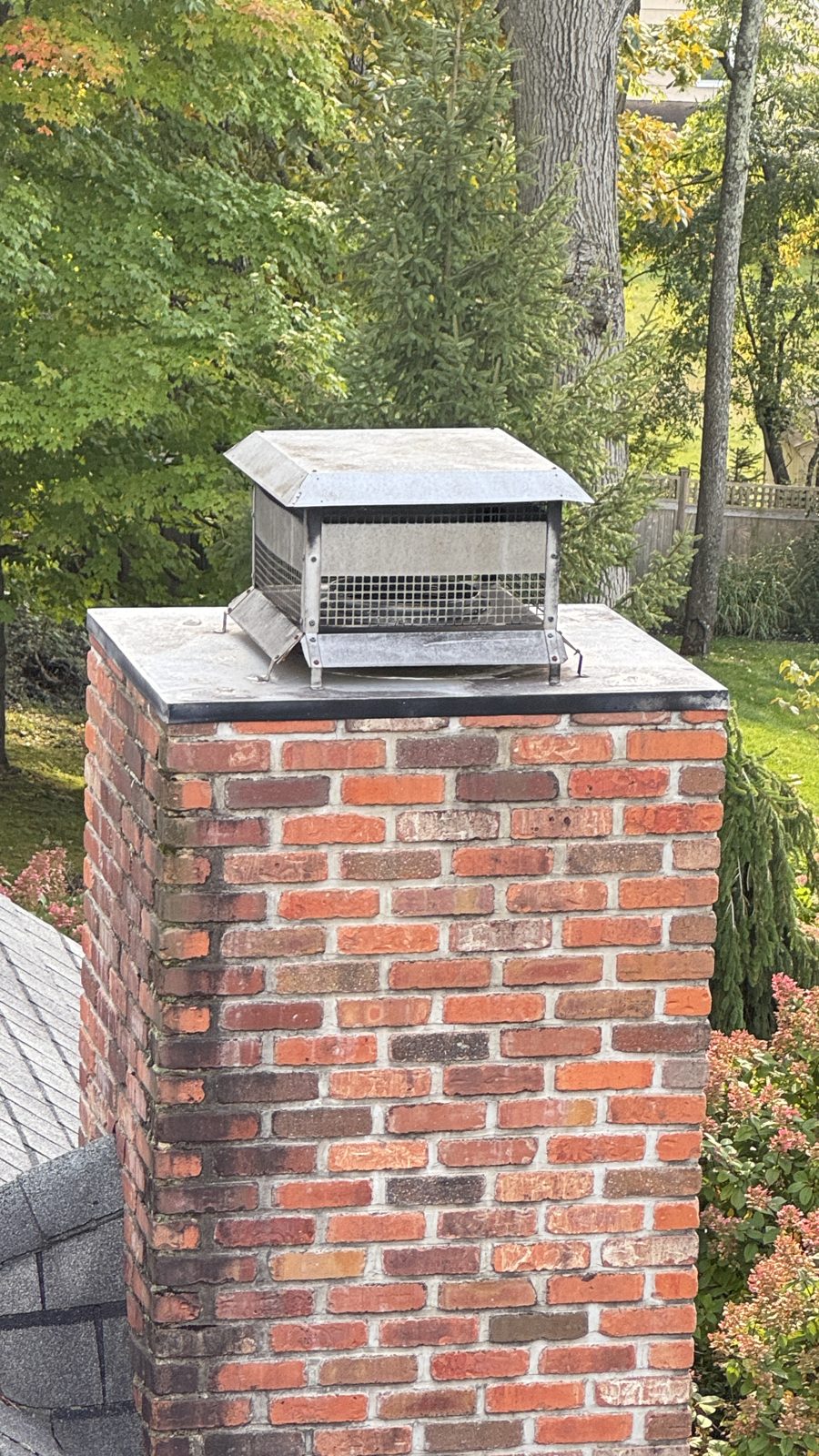
The photo is the before: weathered joints across the stack, and the staining that comes with water getting into the brick.
FlueRite repoints brick chimneys in Randolph, grinding out mortar joints that have eroded and packing them with new mortar to restore the chimney’s strength and keep water out of the brick. On this job the mortar had weathered across the stack, so we repointed the joints to reinforce the chimney before the damage spread further.
- Location
- Randolph, NJ 07869
- Work done
- Chimney repointing to reinforce the stack
- Chimney
- Brick, exposed above the roofline
- Permit
- None required for masonry repair in NJ
- Completed
- Fall 2026
Randolph chimneys are at that age
Randolph covers a lot of hilly ground between Mount Freedom, Shongum Lake, Ironia and Center Grove, and much of it was built up from the 1960s through the 1990s. Many of those homes have tall brick chimneys standing exposed above the roofline, which is exactly where mortar takes the most punishment.
Exposed chimney mortar typically lasts twenty-five to thirty years before it needs attention. That puts a large share of Randolph chimneys in the window right now.
Why mortar fails before brick
Mortar is meant to be the weaker material. It is softer and more porous than brick on purpose, so that movement and moisture are taken by the joints, which can be renewed, instead of by the brick, which is much harder to replace. Over decades, rain washes out the face of the joints and freeze-thaw cycles break them down from inside.
A chimney is the worst-case spot for that. It stands above the roof with all four faces exposed, takes wind-driven rain on every side, and goes through every freeze and thaw with nothing sheltering it.
What happens if it is left
Once the joints recede, water sits in them instead of shedding off. It soaks into the brick around them, freezes, and starts breaking off the brick faces, which is called spalling. Loose joints near the top let bricks shift, and a chimney that has lost enough mortar can start to lean or drop pieces onto the roof. Water passing through open joints also reaches the flue and the inside of the house.
Repointing at the stage in the photo is a fraction of the work of rebuilding the top of a chimney later.
How we repoint a chimney
Cut out to sound mortar. Failed mortar is ground out of the joints to a consistent depth, about two to two and a half times the width of the joint. Repointing that only skims new mortar over old does not bond and falls out within a few seasons.
Matched mortar. The new mortar has to be softer than the brick. Mortar that is too hard cannot move with the brick, and the brick ends up cracking instead of the joint.
Packed in layers. Deep joints are filled in layers, each one allowed to firm up before the next, then tooled to a profile that sheds water.
The top gets checked too. Joints near the top of a chimney take the most water, often because of a crown or cap problem above them. We check the top at the same time so new joints are not being soaked from above.
How to spot failing joints from the ground
Joints that look recessed behind the brick faces, or sandy and crumbly where they should be solid. Dark staining on the brick, like the left side of the chimney in the photo. White chalky deposits. Bits of mortar or brick on the roof or in the gutters. A zoomed-in phone photo from the yard is usually enough to tell.
Chimney repointing questions from Randolph homeowners
What is chimney repointing?
Repointing, often called tuckpointing, is removing deteriorated mortar from between the bricks and replacing it with new mortar. It restores the strength of the chimney and closes the joints so water stays out of the brick.
How long does chimney repointing last?
Done properly, with joints cut deep enough and mortar matched to the brick, new joints should last for decades. Repointing that only skims the surface tends to fail within a few years.
Can you repoint only part of a chimney?
Yes, when the damage is limited to one area, often the top few feet or the side facing the weather. When joints are failing across the whole stack, as they were on this Randolph chimney, the whole chimney is done so it weathers evenly.
Is repointing the same as rebuilding a chimney?
No. Repointing replaces the mortar and keeps the original brick. A rebuild takes the chimney down, usually to the roofline, and lays it again. Repointing in time is what keeps a chimney from needing a rebuild.
Should a chimney be waterproofed after repointing?
Often, yes, once the new mortar has cured. A breathable masonry water repellent reduces how much water the brick absorbs while still letting moisture inside escape. Paint and non-breathable sealers trap moisture and should not go on chimney brick.
Do you serve all of Randolph?
Yes, including Mount Freedom, Shongum Lake, Ironia and Center Grove, along with Denville, Rockaway, Chester and the rest of Morris County.
Joints looking rough?
Send us a photo or book an inspection. We look at the joints, the brick and the top of the chimney, and tell you whether it needs repointing now or can wait another season.
Mortar crumbling on your chimney?
We repoint to sound mortar and check the top of the chimney while we are up there. Randolph, Mount Freedom, Shongum Lake and the rest of Morris County.
CSIA Certified · NJ HIC #13VH14202300 · Serving Randolph & Morris County