Why is my chimney leaking when it rains?
Six ways water gets in, and how to tell which is yours.
The stain on the ceiling is rarely right under the spot where the water gets in. Here is how we trace a chimney leak back to its source, with photos from jobs in Pompton Plains, Mountain Lakes and Bloomingdale.
By FlueRite Chimney Co. · CSIA Certified · Montville, NJ
· 7 min read
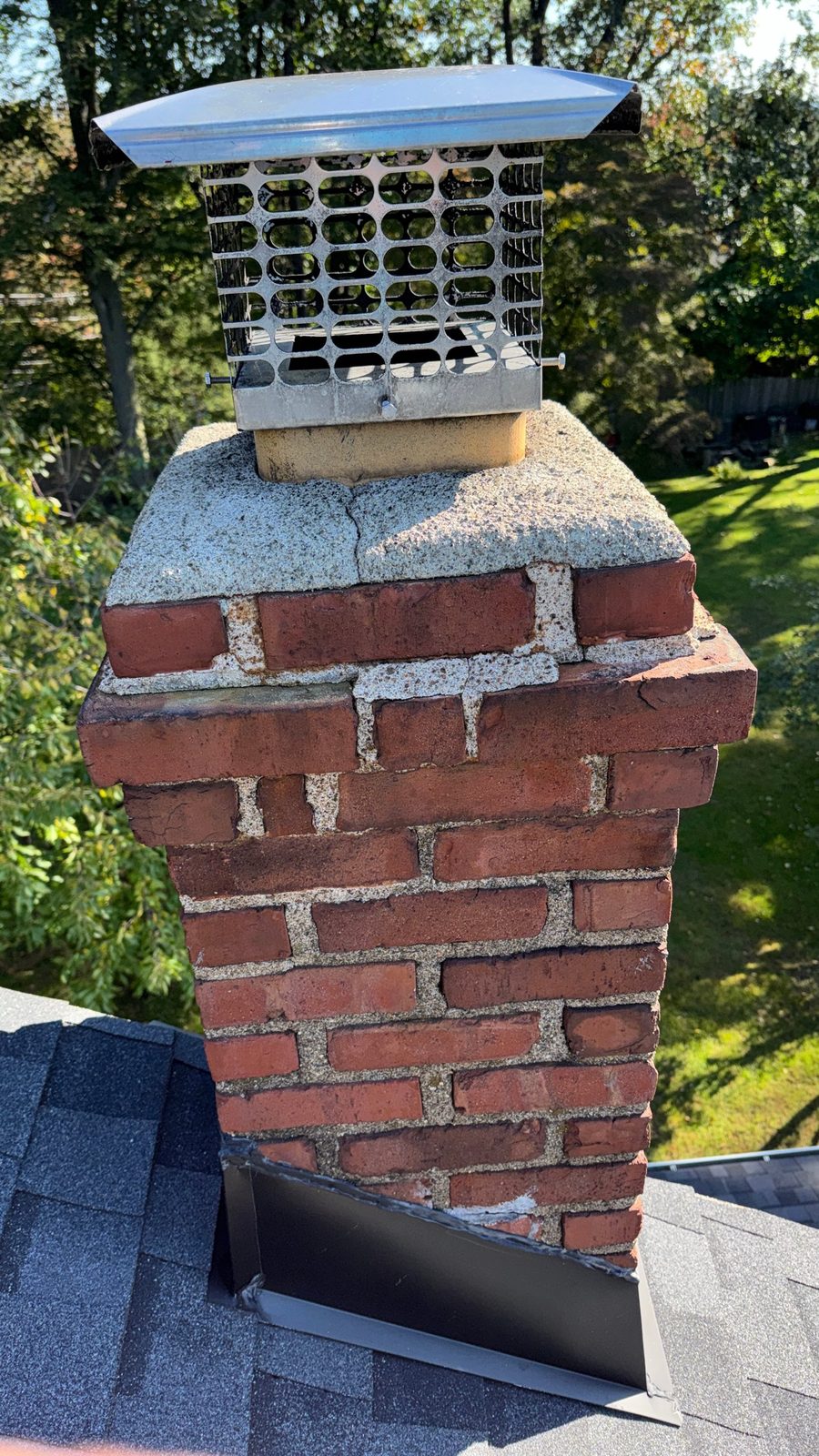
Most chimney leaks come from one of five places: flashing where the chimney meets the roof, a cracked crown, a missing or damaged cap, worn mortar joints and porous brick, or a rusted chase cover on a framed chimney. The sixth cause is not rain at all, but condensation inside the flue. When and where the water shows up usually tells you which one it is.
- Water in the firebox usually comes from the top: the cap or the crown.
- A stain on the ceiling or wall beside the chimney usually means flashing.
- A leak only in wind-driven rain often points to the brick on that side.
- Damp, white-stained masonry with no rain at all points to condensation.
Where does water get into a chimney?
A chimney is a tall masonry box that passes through the roof and stands fully exposed above it. Water has six ways in, and on an older chimney it is common to find two at once.
Flashing. The joint where the chimney passes through the roof is the most common leak we see. Correct flashing is two layers: step flashing woven into the shingles, and counter flashing set into the mortar joints and lapped down over it. When the counter flashing pulls loose, or the joint was smeared with roof cement instead, water runs in behind it. We wrote a full piece on what failed flashing looks like.
The crown. The concrete slab across the top of the chimney. Many are a thin layer of mortar troweled over the top course of brick, and they crack within a few winters. Water goes through the crack into the brick below and down the outside of the flue tile.
The cap. Or no cap. An open flue takes rain straight down to the damper and the firebox floor. A rusted damper and water in the firebox after a storm are the usual signs. More on that in do I need a chimney cap.
Brick and mortar. Brick and mortar absorb water by nature. Once the joints erode, much more gets in, and in a long, wind-driven storm the face of a chimney can soak up enough to show up inside the house.
The chase cover. On a framed chimney, the kind finished with siding or stucco instead of brick, the metal cover on top is the chimney's roof. Galvanized covers rust through, and flat ones hold standing water that finds every seam.
Condensation. Not a leak, but it looks like one. Exhaust from gas and oil appliances carries water vapor, and in a cold or oversized flue it condenses and runs down the inside. It shows up in heating season, rain or not.
What the water is telling you
Where the water appears, and when, narrows it down faster than anything else. Use this to point in the right direction, not as a final answer, because two causes often overlap.
| What you see | When | Most likely source |
|---|---|---|
| Water in the firebox, rust on the damper | During or right after rain | Missing or damaged cap, or a cracked crown |
| Stain on the ceiling or wall beside the chimney | Heavy rain, or snow melting on the roof | Flashing, or no cricket behind a wide chimney |
| Damp patch on one side of the chimney | Wind-driven rain from one direction | Brick and mortar joints on that face |
| A leak that shows up a day or two after rain | After long, soaking storms | Saturated masonry slowly passing water through |
| White powder or crust on the brick | Any time, often in spring | Water moving through the masonry and drying out on the face |
| Damp walls, dripping at the cleanout, a sour smell | Heating season, rain or not | Condensation in the flue |
| Rust streaks on the siding or stucco below the top | After rain | A rusted or flat chase cover |
Why so many leaks start on the uphill side
On the side of a chimney that faces up the roof, rain and melting snow pile up against the brick instead of running past it. That back corner is where flashing fails first.
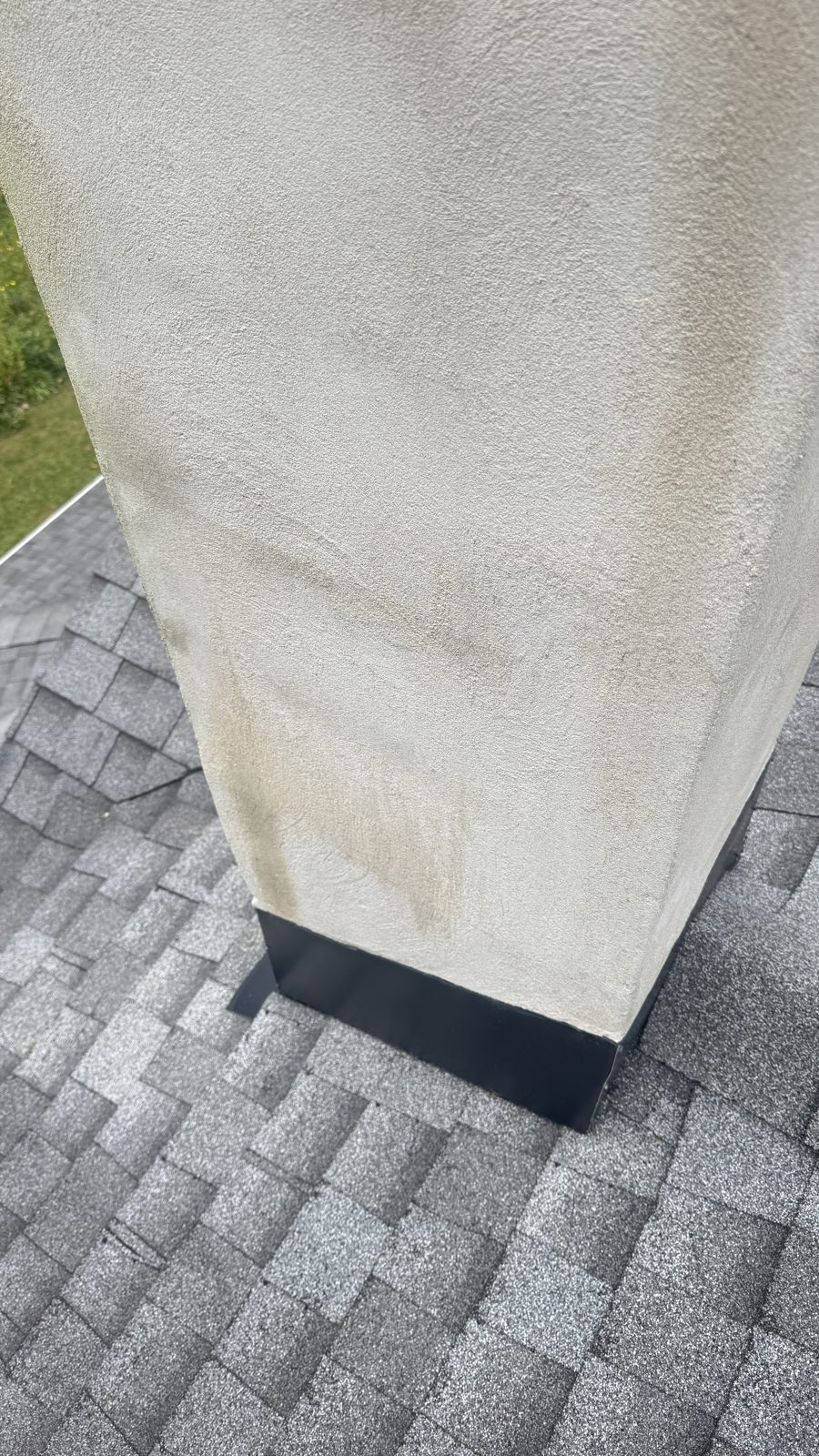
Building code calls for a cricket, a small peaked roof that splits water around the chimney, when a chimney is more than 30 inches wide on that side. Plenty of older homes have wide chimneys and no cricket. When we find that, the leak is not really a flashing failure. It is a design problem the flashing was never going to keep up with, and the lasting fix is adding the cricket when the flashing is redone.
Framed chimneys leak from the top
Many homes built from the 1980s on have framed chimney chases rather than masonry, finished to match the siding or stucco. Their weak point is almost always the chase cover. A cover that is flat, or has sagged, holds water. A galvanized one rusts, and the rust streaks down the walls before it lets water through.
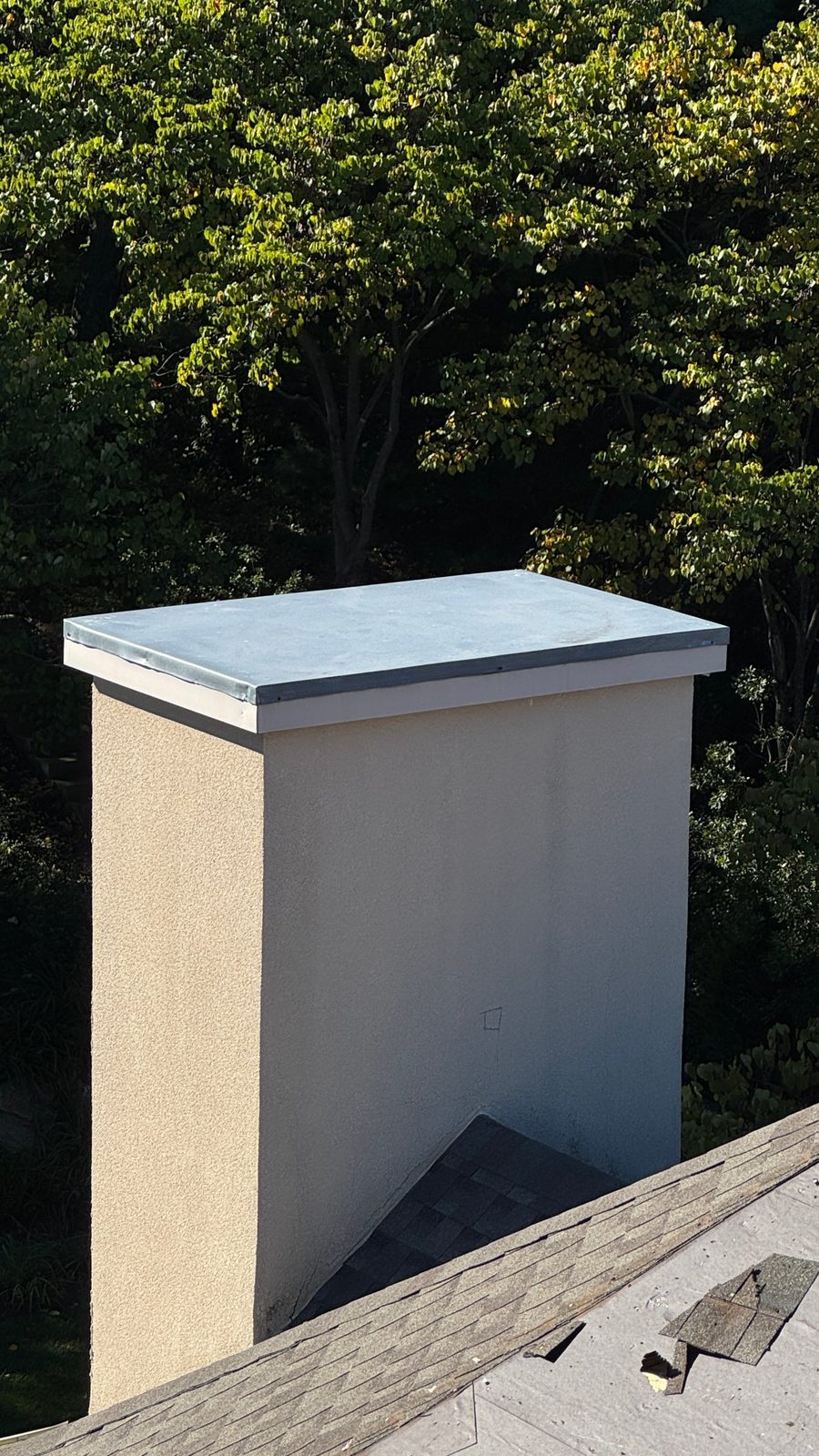
A cover that lasts is stainless or copper, with a slight pitch or cross-break so water runs off, and a skirt that turns down past the top of the walls so the water drips clear of them. When water has been getting in for a while, it is worth checking the framing and sheathing at the top of the chase while the cover is off.
When it is not rain at all
If the dampness shows up in winter whether it rains or not, look at the flue rather than the roof. A common North Jersey version: an old boiler is replaced with a high-efficiency unit that vents out the side of the house, and the water heater is left alone in a flue built for both. That flue is now far too large for it. The exhaust cools, the water vapor condenses, and the moisture soaks through the masonry and stains the outside of the chimney white.
No amount of flashing or sealer fixes that. The fix is a liner sized to the water heater, which is covered in how a chimney liner is installed.
How we find a chimney leak
- Start inside. Where the stain is, how big, and when it appeared. If there is attic access, the framing around the chimney shows whether water is running down the outside of the brick or coming through it.
- Then the roof. Flashing, crown, cap, chase cover and every face of the masonry, photographed so you see what we see.
- Then the flue. A camera down the inside, which rules condensation and flue damage in or out.
- Water test, if needed. When it is still not clear, a hose on one part of the chimney at a time, starting at the bottom and working up, with someone inside watching. Starting low matters, because water from higher up runs down past everything below it.
What not to do while you wait
Do not let anyone trowel roof cement over the flashing. It holds for a season or two, then cracks and traps water against the brick. Do not paint the brick or coat it with a sealer that is not made to breathe. Masonry has to dry out, and a film that traps moisture in it makes freeze damage worse. A breathable water repellent made for masonry is a legitimate step on sound brick after repairs, not a substitute for them.
Chimney leak questions
Why does my chimney only leak in heavy rain?
Usually because the water has to build up before it finds the opening. Flashing that has pulled loose, a cricket that is missing behind a wide chimney, or brick that only passes water once it is saturated all behave this way. Light rain runs off. A long, wind-driven storm gets in.
Why is my chimney leaking in winter when it is not raining?
Two common reasons. Snow melting on the roof backs up against the uphill side of the chimney and gets behind the flashing. Or it is not a leak at all, but condensation inside the flue from a gas or oil appliance, which shows up in heating season whether it rains or not.
Should a roofer or a chimney company fix a chimney leak?
It depends where the water is getting in. Flashing sits between the two trades, and a good roofer can redo it. A chimney company also looks at the crown, the cap, the masonry, the chase cover and the inside of the flue, which is where a leak often turns out to be when new flashing did not stop it.
Will a waterproofing sealer stop a chimney leak?
Only when the water is soaking through sound brick and mortar, and only with a breathable repellent made for masonry. A sealer does nothing for failed flashing, a cracked crown, an open flue or condensation, and a film-forming coating can trap moisture in the brick and make freeze damage worse.
How fast does a chimney leak cause damage?
Faster in winter. Water in the masonry expands when it freezes, so one winter of freeze and thaw can loosen brick and widen crown cracks. Inside, water rusts dampers, stains ceilings and wets framing. A slow leak caught in the fall is a much smaller repair than the same leak found in spring.
Does chimney leak repair need a permit in New Jersey?
Usually not. Flashing, crown, cap, chase cover and masonry repairs fall outside the permit requirement under the New Jersey Uniform Construction Code. The exception is when the fix is a new liner, for example to stop condensation, which needs a mechanical permit on form F370.
If you have a stain right now
Take a photo of the stain and a photo of the chimney from the ground, and note when it showed up and what the weather was doing. That is the most useful thing you can send us, and it is often enough to say which of these it is before anyone climbs a ladder.
Water coming in around the chimney?
We trace it to the source and show you photos of what we find, whether the answer is flashing, the crown, the cap or the flue. Morris County and nearby towns.
CSIA Certified · NJ HIC #13VH14202300 · Serving Morris County