What failed chimney flashing looks like
And why roof cement is not a repair.
A chimney leak almost never announces itself at the chimney. It shows up as a stain on a bedroom ceiling eight feet away, months after the water first got in.
Morris County, NJ · Chimney Flashing
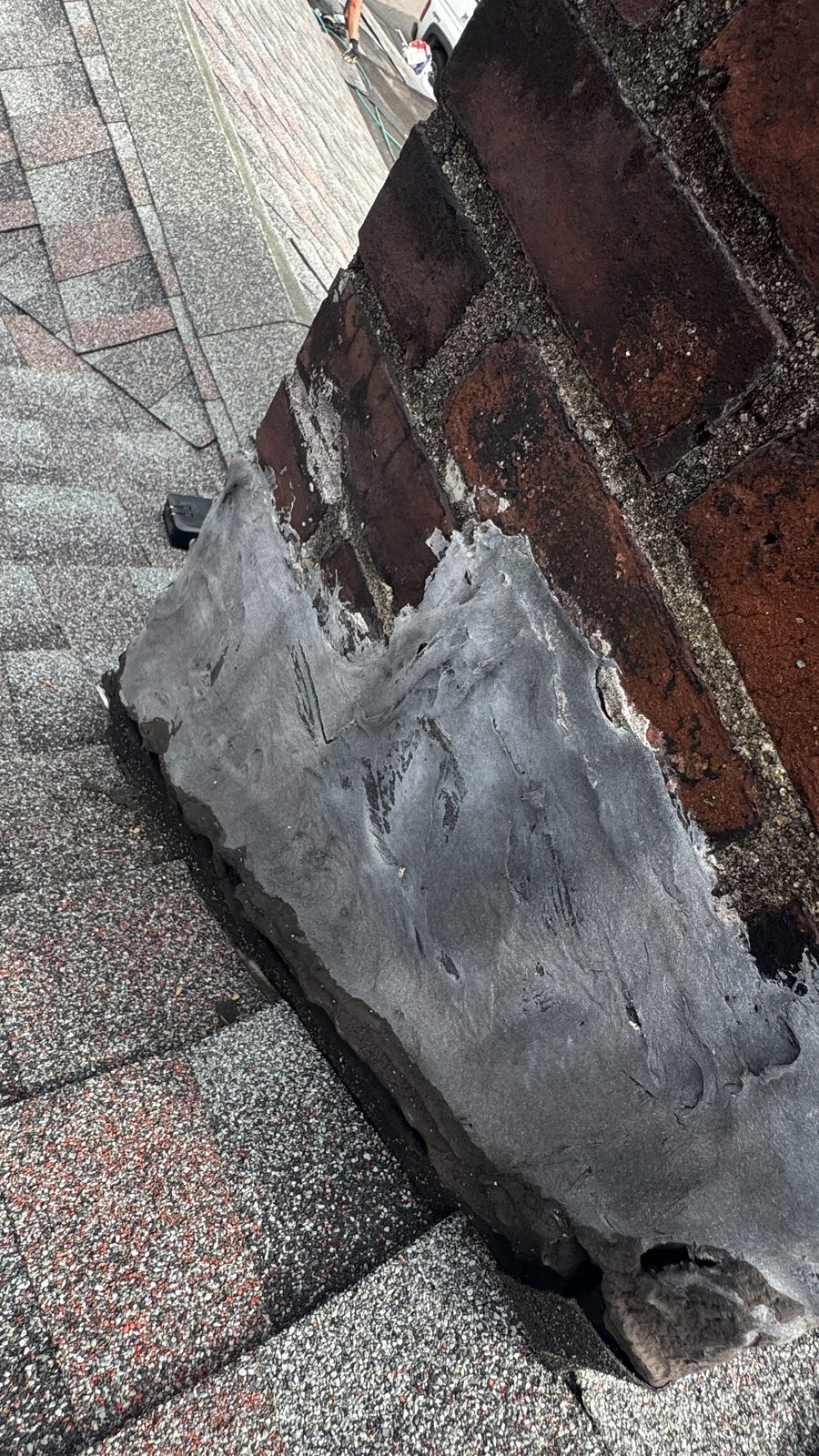
We see this on roughly one chimney in three across Morris County, and the homeowner almost never knows it is there. It is applied by someone who was on the roof for another reason, it looks decisive, and it stops the leak for a little while. That is the whole problem. A repair that works for one season is far more dangerous than one that fails immediately, because nobody goes back to look at it.
What you are actually looking at
Roof cement, sometimes called flashing cement, wet patch, or simply tar, is a petroleum-based compound meant for sealing small punctures and lapping seams on a flat roof. It was never intended to be the water barrier at a chimney. On the chimney above, it was troweled directly across the joint, up onto the brick face, and down over the shingle course.
The person who applied it was not being lazy. It is genuinely faster, it costs a fraction of the material and labor, and on the day it goes on, it does stop the water. A homeowner watching from the driveway sees a problem being solved.
Why it always fails
A chimney is masonry sitting on a footing in the ground. A roof is a wood frame that rests on the walls of the house. They are two separate structures that happen to meet, and they move independently — with temperature, with humidity, with the seasonal shifting every North Jersey house goes through. The joint between them is not a crack to be filled. It is a moving expansion joint, and it has to be built as one.
Roof cement cures rigid, then keeps hardening and shrinking as the oils leach out and ultraviolet light breaks it down. Rigid material across a moving joint has exactly one outcome. It cracks, usually within the first full freeze-and-thaw cycle. Look closely at the photo and the fractures are already running through it.
Now the situation is worse than before it was applied. Water runs into the cracks and sits behind the cement instead of draining off the roof, held against the brick and the sheathing. The masonry stays saturated through the winter, which accelerates spalling and mortar loss. And the material has to be ground off the brick before correct flashing can be installed, which is slow, ugly work that adds cost to the real repair.
What correct flashing is
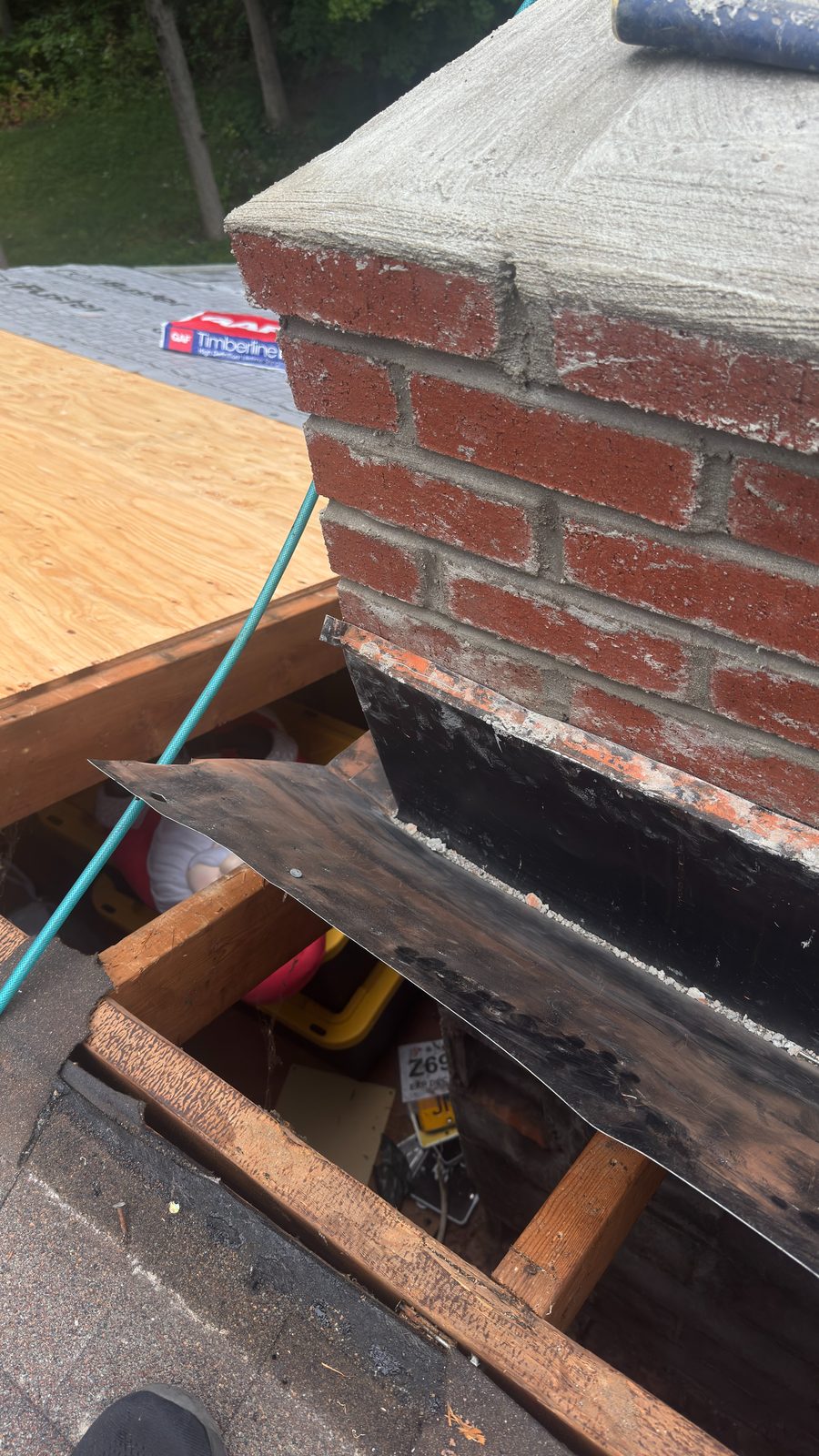
Correct flashing is two independent layers of metal that overlap without being fastened to one another.
Step flashing is a series of L-shaped pieces, one per shingle course, woven in as the roof is laid. Each piece laps the one below it, so water running down the side of the chimney is handed from one piece to the next and out onto the roof.
Counter flashing is the second layer. A groove is cut into the mortar joints of the brick, the metal is set into that groove and sealed, then bent down so it covers the top edge of the step flashing. Water running down the brick face hits the counter flashing and is carried outward onto the step flashing below.
The two layers are never joined. That gap is deliberate, and it is what lets the roof and the chimney move without tearing the assembly apart. Done properly, it lasts as long as the roof it sits in. There is nothing to reseal, nothing to maintain, and no annual visit required.
How to check your own chimney
You do not need to get on the roof, and we would rather you did not. Stand back on the lawn where you can see the full line where the chimney meets the shingles, and use your phone camera zoomed in.
Clean, bright metal stepping up the side of the chimney in a regular pattern is what you want to see. A continuous gray, black, or silver smear with no visible metal edges means cement, not flashing. Rust streaks running down onto the shingles mean the metal that is up there has reached the end of its life. A dark line or visible gap where the brick meets the roof means water has a direct path in.
Inside the house, the symptoms show up late and away from the source. Water stains on a ceiling near the chimney chase, a musty smell in the attic a day or two after heavy rain, white powdery residue on interior brick, or rust on the damper are all worth a look, even if the roof appears sound from the ground.
What the water does while you wait
Flashing failure is slow, and that is precisely why it is expensive. Water entering at the roof line runs down the outside of the chimney inside the wall cavity, where nothing is visible. It saturates sheathing and framing, and in an unvented chase it has nowhere to dry out. By the time a ceiling stain appears downstairs, the water has usually been working for one or two seasons.
A flashing repair on its own is straightforward work. The same leak left for three winters becomes rotted sheathing, a rebuilt chimney crown, interior drywall, and sometimes framing. The repair does not get harder over time. Everything around it does.
Common questions
Can I just use roof cement to stop a chimney leak?
It buys a season, sometimes two. Roof cement cures rigid, and the joint between a masonry chimney and a wood-framed roof never stops moving. Brick and steel and lumber all expand at different rates, so the joint opens and closes with every temperature swing. The cement cracks, water runs into the cracks, and now it is trapped beneath a layer that has to be chiseled off before anyone can do the repair properly. Every year it stays up there, the eventual fix gets more expensive.
What does correct chimney flashing actually consist of?
Two separate layers that are not fastened to each other. Step flashing is a series of L-shaped metal pieces woven in between the shingle courses running up both sides of the chimney. Counter flashing is a second layer, cut into the mortar joints of the brick and bent down over the top of the step flashing. The overlap sheds water while still allowing the roof and the chimney to move independently. That independence is the entire design.
How do I know if my flashing is failing?
From the ground, look at the line where the chimney meets the roof. A thick gray or black smear instead of clean metal is the clearest sign, along with rust staining running down the shingles or any visible gap at the brick. From inside, watch for stains on the ceiling near the chimney chase, a damp smell in the attic a day or two after heavy rain, or rust on the damper.
Is a chimney leak always the flashing?
No, and assuming so is how money gets wasted. Water also enters through a cracked crown, spalled brick, failed mortar joints, or an open flue with no cap. Flashing is the most common single cause, but a proper diagnosis rules out the others first. New flashing on a chimney that is actually leaking through the crown fixes nothing, and the homeowner is left paying twice.
Does chimney flashing work require a permit in New Jersey?
No. Flashing, masonry, caps, crowns, and sweeping are not permit work under the New Jersey Uniform Construction Code. Liner installation is the exception, because it falls under the mechanical subcode and requires form F370 to be filed.
If you are seeing this on your own roof
A chimney with roof cement at the base is not an emergency, but it is a clock running. The honest first step is finding out whether the flashing is the actual leak path, because a cracked crown or an open flue produces identical stains on the same ceiling. That is an inspection, not a quote, and it should come with photographs of what is actually up there.
We will tell you which of those it is before anyone talks about scope. If the flashing is sound and the crown is the problem, we will say so.
Not sure what is holding water out of your chimney?
We photograph what is actually up there and show you before we recommend anything.
CSIA Certified · NJ HIC #13VH14202300 · Serving Morris County