Chimney flashing repair in Mountain Lakes, NJ
Where the chimney meets the roof is where most leaks start.
Flashing is a few feet of metal doing the hardest job on the roof. This Mountain Lakes visit was flashing and a sweep.
FlueRite repairs and replaces chimney flashing in Mountain Lakes, the metal that seals the joint between the chimney and the roof. On this job we redid the flashing at the roofline and swept the chimney in the same visit, so the homeowner went into the heating season with a dry chimney and a clean flue.
- Location
- Mountain Lakes, NJ 07046
- Work done
- Chimney flashing repair and chimney sweep
- Chimney
- Stucco finish, asphalt shingle roof
- Permit
- None required for flashing or sweeping in NJ
- Completed
- Fall 2026
Old homes, wet roofs
Mountain Lakes is one of the most distinctive towns we work in. Much of the borough was built in the 1910s and 1920s, including the Hapgood houses the town is known for, on wooded lots around Mountain Lake, Birchwood Lake and Crystal Lake. Older homes, mature trees and a lot of shade add up to roofs that stay wet long after every storm.
The chimney-to-roof joint is where that water finds its way in. It is the one place on the roof where two different structures meet, and it depends entirely on the flashing to stay dry.
What flashing does
The chimney and the house settle at different rates and move differently with temperature, so the joint between them cannot be sealed with anything rigid. Flashing solves that in two layers that overlap instead of being glued together.
Step flashing is woven into the shingles course by course along the sides of the chimney, each piece lapping the one below it so water runs down and out. Counter flashing covers the top edge of the step flashing and is set into the chimney itself, cut into the mortar joints on brick or tied in behind the finish on stucco. Water running down the chimney lands on the counter flashing and is carried out over the step flashing onto the shingles.
How chimney flashing fails
Roof cement instead of metal. The most common repair we find is tar or roof cement troweled over the joint. It holds for a season or two, then shrinks, cracks and pulls away, and it hides what is underneath.
Counter flashing that is only caulked. Counter flashing pressed against the face of the chimney and sealed with caulk, instead of set into it. Once the caulk lets go, water runs straight behind the metal.
Stucco chimneys. On a stucco chimney, the flashing has to work with the stucco, not just sit against it. Water that gets behind the stucco above the roofline runs down inside it and comes out below the flashing, in the attic.
Reused flashing on a new roof. Old flashing is often bent back into place during a re-roof. It is behind a lot of leaks that first appear a year or two after a new roof goes on.
Signs your chimney flashing is leaking
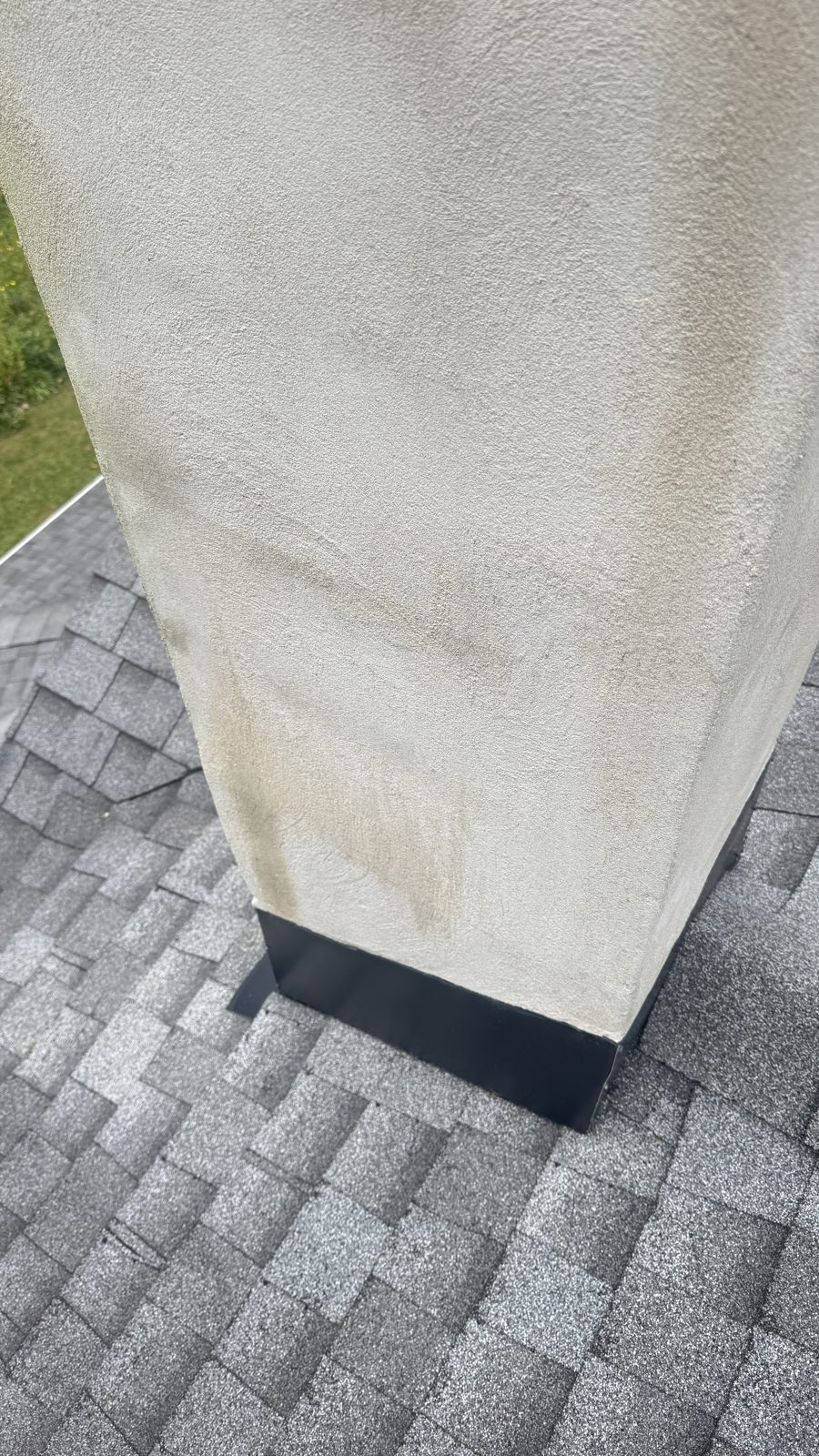
Inside, look for stains on the ceiling or wall right beside the chimney, especially after wind-driven rain, and damp or darkened wood around the chimney in the attic. Outside, look for black tar smeared across the joint, gaps between the metal and the chimney, and staining on the chimney face just above the roofline, like the staining in the photo above. Water in the firebox is usually the cap or the top of the chimney, not the flashing.
Why we swept the chimney the same day
Once we are on the roof for flashing, it is the efficient time to sweep the flue. It also means looking down the flue and at the top of the chimney while we are up there, because a leak can have more than one source. Fixing the flashing and leaving a cracked top above it just moves the leak.
The National Fire Protection Association standard calls for chimneys to be inspected every year and swept as needed. For a fireplace used through a North Jersey winter, that usually means once a year, before the season starts.
Chimney flashing questions from Mountain Lakes homeowners
How do I know if a leak is coming from the chimney flashing or the roof?
Location and timing. A stain directly beside the chimney that shows up after windy storms points to the flashing or the chimney face above the roofline. A stain away from the chimney is more likely the roof itself. In the attic, follow the water up: if the wet wood is at the chimney, the chimney is the source.
Can chimney flashing be repaired, or does it need to be replaced?
If the metal is sound and only the counter flashing seal has failed, it can sometimes be reset. If the step flashing is rusted, short, bent, or buried in roof cement, it should be replaced. We tell you which after looking at it, with photos.
Should chimney flashing be replaced when I get a new roof?
In most cases, yes. Reusing old flashing under new shingles is common and is behind many leaks that show up a year or two after a re-roof. If a roof replacement is coming, it is the right time to have the chimney flashing done properly.
Is roof cement around the chimney a proper fix?
No. Roof cement is a temporary patch. It dries, shrinks and cracks with temperature swings, and it covers the joint so the next person cannot see what is underneath. A lasting repair uses metal step and counter flashing.
How often should a chimney in Mountain Lakes be swept?
The NFPA standard is an inspection every year, with sweeping when there is enough buildup to need it. For a fireplace or stove used through the winter, that is usually yearly. Older chimneys, like many in Mountain Lakes, are worth inspecting every year regardless, because the tile and mortar are often original.
How close is FlueRite to Mountain Lakes?
We are based in Montville, about ten minutes away. Mountain Lakes, Boonton, Denville and Parsippany are all close to home for us.
Leak by the chimney?
Before anyone puts more tar on it, have the joint looked at. We photograph the flashing, the chimney face and the top of the chimney, and show you where the water is actually getting in.
Leak around the chimney?
Flashing done in metal, not tar, and the flue swept while we are up there. Mountain Lakes, Boonton and the rest of Morris County.
CSIA Certified · NJ HIC #13VH14202300 · Serving Mountain Lakes & Morris County