Chimney liner and cap installation in Boonton, NJ
The flue, the top and the roofline, fixed in one visit.
Three repairs on one chimney, and all three were about keeping water and exhaust where they belong.
FlueRite installs stainless steel chimney liners and caps in Boonton, and repairs the flashing where the chimney meets the roof. On this Boonton job we did all three in one project: a new stainless liner through the flue, a new cap on top, and flashing repair at the roofline.
- Location
- Boonton, NJ 07005
- Work done
- Stainless steel liner, new chimney cap, flashing repair
- Liner
- Stainless steel, sized to the appliance
- Permit
- NJ form F370 for the liner, filed by FlueRite
- Completed
- Fall 2026
Three fixes, one chimney
A liner, a cap and flashing sound like three separate jobs. On a chimney they are one system. The liner carries exhaust safely out of the house. The cap keeps rain and animals out of the liner. The flashing keeps water from getting in where the chimney passes through the roof.
Doing them together matters. A new liner under an old cap, or a new cap on a chimney still leaking at the roofline, leaves a weak point that undoes the rest. On this job the roof was already opened at the base for the flashing, so everything was handled while we were up there.
Older chimneys in Boonton
Boonton grew up around the ironworks on the Rockaway River in the 1800s, and much of the town’s housing, especially on the hill above Main Street, is a century old or more. Boonton Township around it is newer, wooded and spread out. Between the two, we see every generation of chimney: unlined brick, early clay tile, and mid-century flues serving furnaces that have been replaced two or three times since.
The older the flue, the more likely it was never sized for what is connected to it today. That is the most common reason a chimney in a town like Boonton ends up needing a liner.
What the top of this chimney was telling us
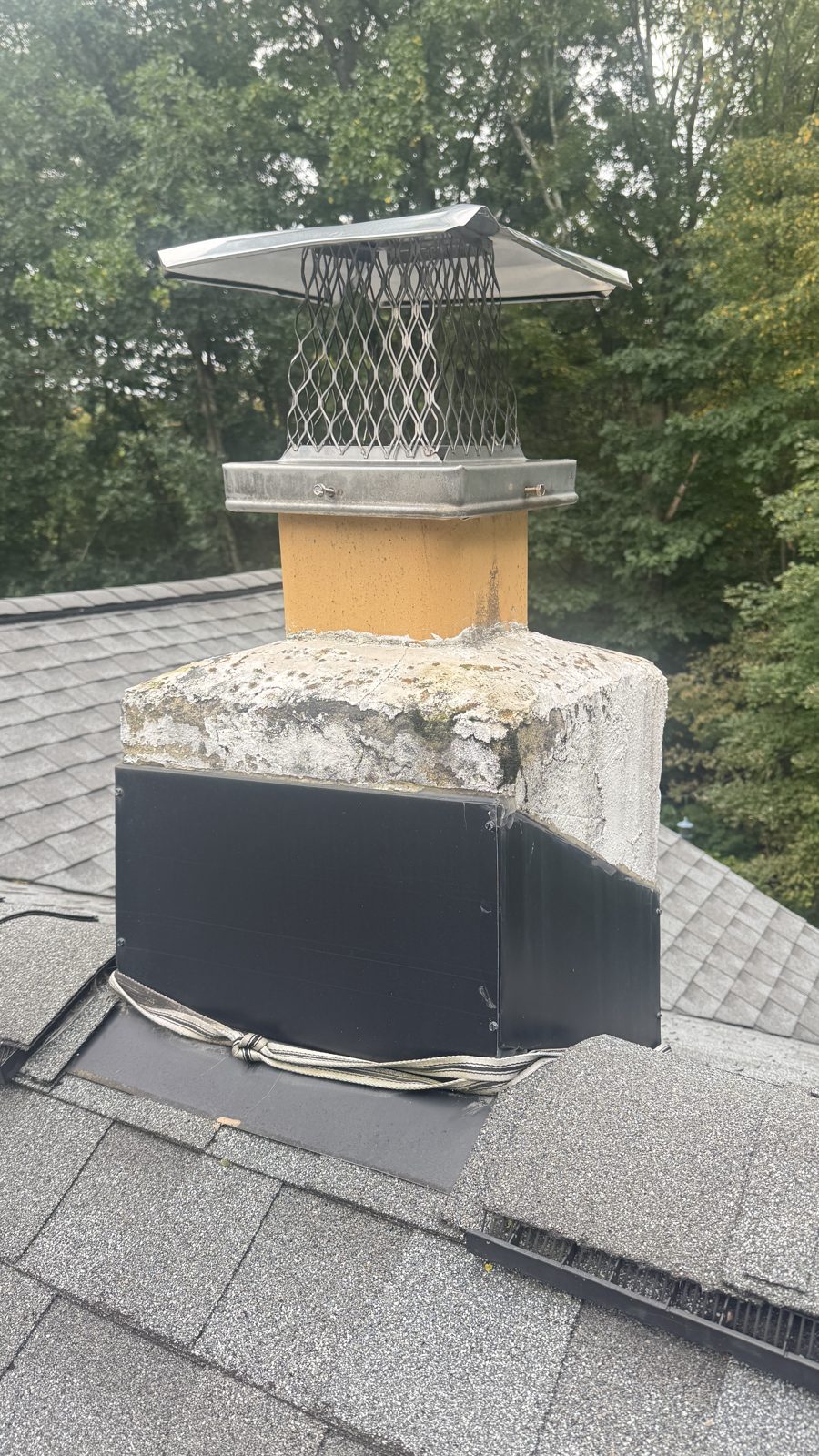
Look at the top in the photo. The cement around the flue tile is crumbling, stained and growing moss. That layer is meant to shed water off the top of the chimney. Once it breaks down, water soaks into the masonry below it and runs down the outside of the flue tile.
Moss on a chimney top is a moisture signal, not a cosmetic one. It only grows where the surface stays wet.
Why a new liner gets a new cap
When a stainless liner goes in, it is sealed at the top of the chimney, and the cap is fitted to that new termination rather than clamped onto the old clay tile. The old cap was sized for the old flue. A new liner almost always means a new cap that fits it properly.
We use stainless caps for the same reason we use stainless liners. Painted and galvanized steel rusts, and rust streaks down the chimney within a few years.
Flashing at the roofline
Flashing is the metal that seals the joint where the chimney comes through the roof. Done right, it is two layers: step flashing woven into the shingles, and counter flashing set into the chimney and lapped over it. Done wrong, it is roof cement smeared over the joint, which cracks within a couple of seasons.
In the photo the shingles are pulled back from the base of the chimney. That is what a proper flashing repair looks like partway through: the old material comes out so the new flashing can be woven in, not laid on top.
Permits in Boonton
The liner requires New Jersey form F370 under the mechanical subcode of the Uniform Construction Code, filed with the construction office and inspected. We file it ourselves. The cap and flashing work need no permit.
Questions from Boonton homeowners
Can a chimney liner, cap and flashing be done in the same visit?
Yes, and when a chimney needs all three it usually should be. They protect the same chimney from the same water, and doing them together means one setup on the roof instead of three, with nothing left as the weak point.
Why does a new chimney liner need a new cap?
The liner is sealed at the top of the chimney, and the cap has to fit that new termination. A cap that was clamped to the old clay tile usually does not fit a stainless liner correctly, so it gets replaced as part of the job.
Do older homes in Boonton need chimney liners?
Not automatically. Many do, because the original flue is unlined, cracked, or sized for appliances that have since been replaced. The way to know is an inspection of the flue. If the existing flue is sound and properly sized, it does not need a liner.
What is the crumbling cement on top of my chimney?
It is usually a mortar wash, a thin layer troweled around the flue tile to shed water. It is porous and cracks over time, and once it breaks down, water gets into the masonry. Moss or plant growth on top of the chimney is a sign it is staying wet.
Is chimney flashing a roofer’s job or a chimney company’s job?
Either can do it, and the step flashing is tied into the roof. The counter flashing is tied into the chimney, and that half is where most failures start. We do both halves, so the joint is handled as one piece.
How close is FlueRite to Boonton?
Very close. We are based in Montville, which borders Boonton, so Boonton and Boonton Township are a few minutes from us.
Not sure what your chimney needs?
Start with an inspection. We look at the flue, the top and the roofline, show you photos of all three, and tell you which of them actually need work.
Chimney work in Boonton?
Liners, caps and flashing, inspected and photographed before anything is quoted. Boonton, Boonton Township and the rest of Morris County.
CSIA Certified · NJ HIC #13VH14202300 · F370 Filed On Every Liner