Chimney crown repair in Martinsville, NJ
The slab on top is what protects everything below it.
When a crown fails, nothing looks wrong for a long time. Then the brick starts flaking and the repair is no longer a crown repair.
Martinsville sits in Bridgewater Township, Somerset County, up against the Watchung ridge where Chimney Rock Road climbs toward Washington Valley Park. It is a good place to live and a hard place to be a chimney. Homes along that ridge take wind-driven rain from the exposed side, and a chimney stack standing above the roofline catches all of it. The crown is the only thing between that water and the masonry underneath.
Most of the crowns we cut off in this area were never crowns to begin with.
What the crown actually does
The crown is the concrete slab across the top of the chimney, surrounding the flue tile and covering the brick. Its whole job is to take the water that lands on top of the chimney and throw it clear of the structure.
People confuse it with the cap, which is a different part doing a different job. The cap is the metal cover over the flue opening, keeping rain, birds and debris out of the flue itself. The crown protects the masonry. A chimney needs both, and one failing tells you nothing about the other.
Why crowns fail here
When a mason finishes a chimney, the fast way to close the top is to trowel a layer of the mortar already mixed on site across the brick and slope it toward the edges. That is a wash, not a crown. It is thin, it is unreinforced, it usually stops flush with the brick face instead of projecting past it, and mortar is porous and brittle in ways concrete is not.
A wash cracks. Water gets into the crack, freezes on a January night, expands, and makes the crack wider. Do that across a few North Jersey winters and the slab is broken into pieces. Now water pours straight into the top of the chimney, into the brick and into the gap around the flue tile.
Even a properly poured crown fails if it was poured solid against the flue tile. The tile gets hot and expands, the concrete does not move with it, and the slab cracks in a ring around the flue. That one is not about weather. It is about how the crown was built.
What you will see when it is going
You can check the main signs yourself with a phone camera and a zoom, standing back far enough to see the top of the stack. You do not need to get on the roof.
On the crown, look for cracks running out from the flue tile, missing chunks along the edges, or a surface that reads as gray mortar rather than smooth concrete. On the brick below, white powdery staining is mineral salts carried out of the masonry by water passing through it, and brick faces flaking or popping off means water has been freezing inside the brick. Inside the house, a rusted damper, a musty smell near the firebox, or staining on the chimney breast all come late, well after the crown started leaking.
How we rebuild one
The failed crown or wash comes off entirely. Anything underneath it that has deteriorated, including the top courses of brick where water has been sitting, gets addressed first, because a new crown poured over soft brick does not last either.
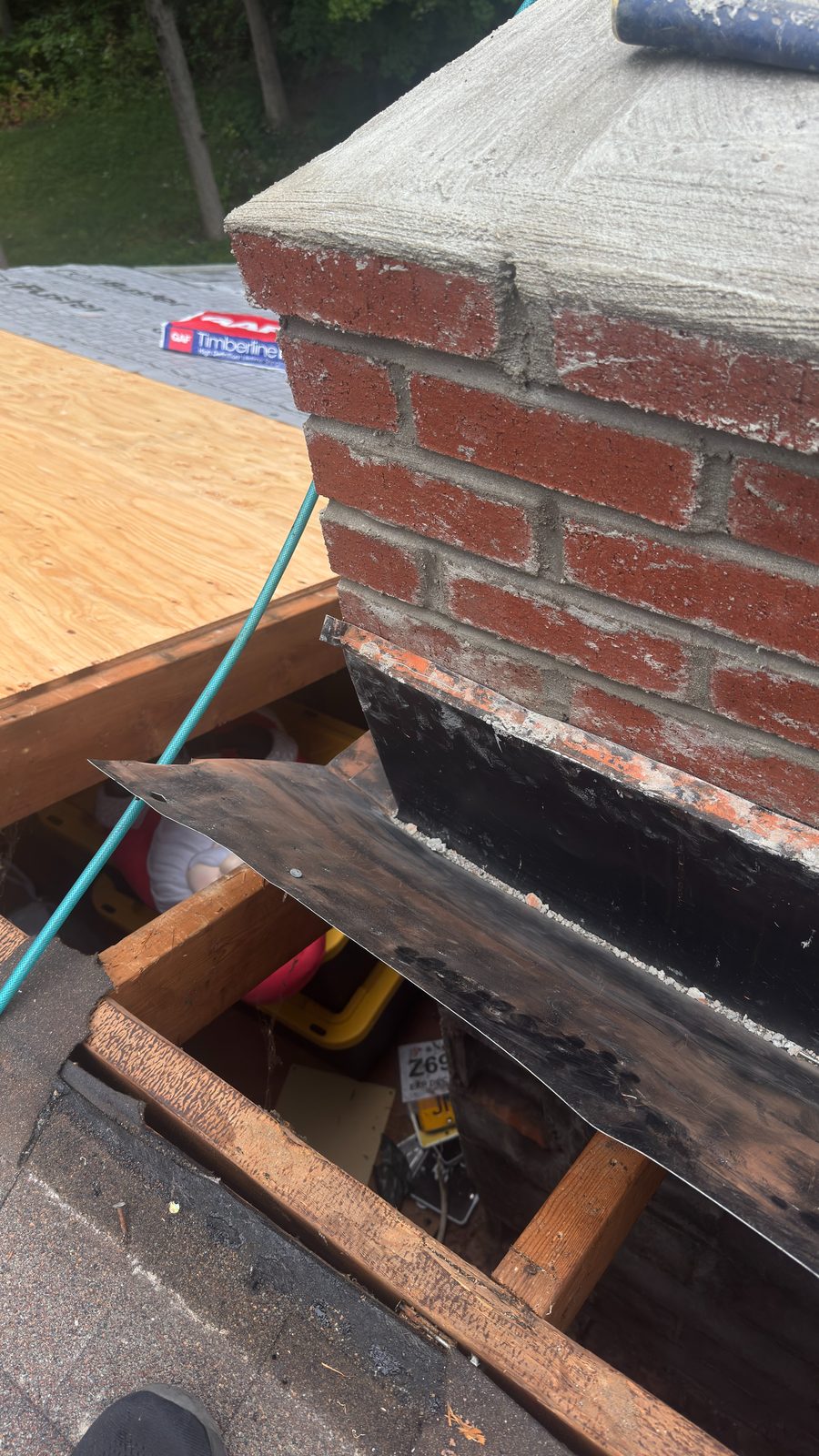
The new crown is poured concrete, reinforced, sloped away from the flue. It projects past the face of the brick with a drip edge formed into the underside, so runoff falls clear of the chimney rather than tracking down the masonry. At the flue tile we leave a bond break, so the tile can expand with heat without cracking the slab. If the flashing at the roofline is failing too, as it was on the job above, that gets done in the same visit, because they are the same water problem.
Permits in New Jersey
Crown work needs no construction permit. Under the New Jersey Uniform Construction Code, chimney crowns, caps, masonry, flashing and sweeping are all outside the permit requirement. The one exception in chimney work is liner installation, which falls under the mechanical subcode and requires form F370. If your crown turns out to sit over a failed liner, we file that ourselves rather than handing you paperwork.
Common questions
What is a chimney crown, and how is it different from a chimney cap?
The crown is the concrete slab at the very top of the chimney that covers the brickwork and slopes away from the flue. The cap is the metal cover that sits over the flue opening itself. They do different jobs. The crown keeps water out of the masonry, the cap keeps water, animals and debris out of the flue. A chimney needs both, and they fail for entirely different reasons.
How do I know if my chimney crown is cracked?
From the ground with a zoomed phone photo, look at the top slab for hairline or open cracks radiating from the flue tile, chunks missing at the edges, or a surface that looks like mortar rather than concrete. Below the crown, white chalky staining on the brick, dark saturation lines, or brick faces flaking off all point to water coming through the crown. Inside, rust on the damper and a musty smell near the firebox are common late symptoms.
Why do so many chimney crowns crack?
Most were never built as crowns. A builder finishing a chimney often trowels a thin skim of mortar across the top, sloped just enough to shed water. That is called a wash, and mortar is porous and brittle in a way concrete is not. It develops hairline cracks within a few winters, water gets in, freezes, and widens them. Once a wash starts breaking up, patching it is a temporary measure at best.
What does a correctly built chimney crown look like?
Poured concrete rather than mortar, reinforced, sloped away from the flue so water runs off rather than sitting. It projects past the face of the brick with a drip edge cut into the underside, so runoff drops clear of the masonry instead of tracking down it. And it is not bonded to the flue tile. A bond break at that joint lets the tile expand and contract with heat without cracking the slab around it, which is what happens when the two are poured solid together.
Can a cracked crown be sealed instead of replaced?
Sometimes, and we will tell you which case you are in. Tight hairline cracks in a crown that is otherwise sound, correctly shaped and properly overhanging can be sealed with a flexible crown coating, and that buys real years. A crown that is spalling apart, has no overhang, or was only ever a mortar wash needs to be cut off and rebuilt. Coating a failed crown just hides it.
Does chimney crown repair require a permit in New Jersey?
No. Under the New Jersey Uniform Construction Code, chimney crowns, caps, masonry and sweeping are not permit work. Liner installation is the exception, because it falls under the mechanical subcode and requires form F370 to be filed. If your crown repair turns out to involve relining, we handle that filing.
Do you serve Martinsville and the rest of Somerset County?
Yes. FlueRite is based in Montville and works throughout Morris and Somerset counties, including Martinsville, Bridgewater, Basking Ridge, Bernardsville, Far Hills and Bedminster. Martinsville is roughly a half hour out and we schedule it the same as anywhere else in our area.
Before we quote anything
A cracked crown and a failed cap and bad flashing produce the same ceiling stain, and we have been called out for one and found another. So the first visit is an inspection with photographs of what is actually on top of your chimney, and you see them before anyone discusses scope.
If the crown is sound and the real problem is elsewhere, we will say so. That is a cheaper answer for you and an easier business for us to run.
Crown looking rough from the driveway?
We photograph the top of the chimney and show you what is there before we recommend anything. Martinsville, Bridgewater and the rest of Somerset County.
CSIA Certified · NJ HIC #13VH14202300 · Serving Martinsville & Somerset County